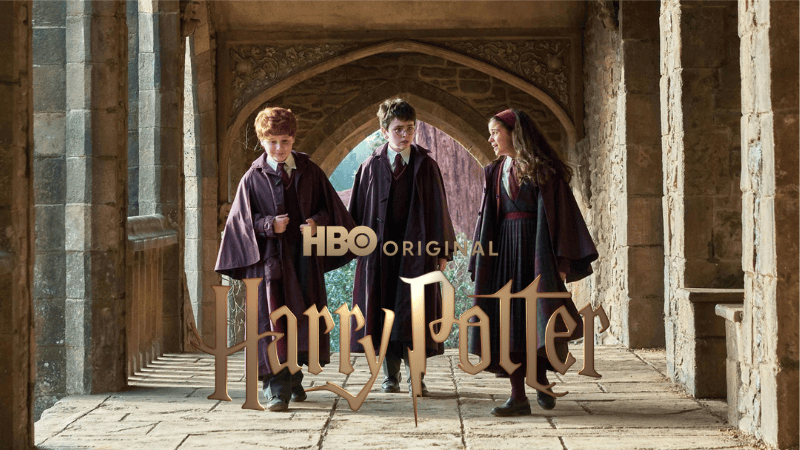
Warner Bros. might be lining up the most successful show of the year, with their reboot of Harry Potter and the Philosopher’s Stone, coming to HBO this Christmas.
From everything we’ve seen of the show so far, it seems to raise the question, is this necessary?
To be fair, it’s not strictly a reboot or a remake, it’s actually a re-adaptation. The 2005 The Lion, The Witch and The Wardrobe wasn’t a remake just because the BBC made their own series back in the 1980s. It is notable though that the HP series is being made again by Warner Bros., and seems to be borrowing quite a bit from the movies.
The trailers give a sense of deja vu. So many scenes have been recreated one-for-one, and many aspects of the design and aesthetic are indistinguishable from the films. So why are they doing this?
First, the movies were, on the whole, good adaptations, and quite well-received. Coming along when Potter mania was at its height, they set the standard for what the Wizarding World should look like. Peter Jackson’s Lord of the Rings trilogy did a similar thing for Middle-earth, leading Amazon to copy them with Rings of Power. Even though the two projects aren’t officially connected, they share a common aesthetic, so as to give fans a familiar setting.
The Potter movies also got so many aspects spot on that it’s hard to outdo them, and seeing as WB doesn’t need to worry about infringing its own copyright, they may as well copy/paste them into the show, hence why Hagrid, Dumbledore, Quidditch kits, and school uniforms look so familiar.
With Warner still holding all the screen rights to HP, they have another good reason to maintain a visual continuity. They still sell a huge amount of merchandise, and millions visit the Wizarding World attraction on the studio tour. Keeping the two projects indistinguishable means fans can buy merch from either of them, and not see any big difference. Even the logo is staying the same, a sure sign they want to keep continuity with the brand.
An amusing response to the series’ trailers has been the number of people asking *why* it’s being made; who is it for; what’s the point if it’s a shot-for-shot remake? Well money, obviously, and the last decade or more of entertainment have shown that to be a very lucrative strategy: The Force Awakens, the Disney live-action remakes, How to Train Your Dragon. It seems the closer you get to the original, the more success you’ll have.
Most of the big successes like Lilo & Stitch or The Lion King, are based on movies released around 20-30 years ago. It’s the perfect age to cash in on childhood nostalgia, whether for parents eager to introduce kids to their old favourites, or just adults looking for a nostalgia hit. It’s hard to think of a bigger candidate for nostalgia than Harry Potter, which dominated pop culture for more than a decade, and formed a part of so many millions of childhoods.
A nostalgia reboot is WB’s best chance of a hit, as it’s surprisingly difficult to make anything new in the WW universe. The whole appeal of the series is it’s really British; Hogwarts is a copy of the public boarding schools, full of old tweedy professors, creaky Mediaeval streets, libraries of dusty, leather-bound books, comfy armchairs, corridors lit by flickering lamps, and mysteries waiting to be discovered. The “dark academia” aesthetic of Tumblr and Pinterest.
A series set in the American Ilvermorny wizarding school would miss out on that, and the world itself is so small, with wizards living in just a handful of areas through Britain, that there’s not much scope to set it elsewhere. Hogwarts is the most valuable asset, as Hogwarts Legacy shows; it’s the main setting for the entire saga, and the concept of a school for witches and wizards is the unique concept that made the story so popular in the first place. It’s hard to do anything without returning there, but a show based around some other characters, such as the Marauders, would naturally miss out on the stakes of the original books, the Chosen One prophesy, Voldemort, and world-changing conflict. As J.K. Rowling has written very little wizarding stories outside of the main seven, it would require a lot of original storytelling too, which she might not be willing to sanction.
I don’t doubt this will be a success for HBO either. Harry Potter is still a very popular property, as things like Hogwarts Legacy show, and the incredibly popular Wizarding World attractions and studio tours. Those who grew up with Potter in the early 2000s can relive that time again, or else introduce their kids to it, creating a new generation of fans.
It also has a good release slot around Christmas. The whole aesthetic of the world lends itself well to cosy winter nights in, but Philosopher’s Stone even more so, especially if they can bring a bit more light and warmth to the colour grading. Any idea it will be a flop, at least for this first season, is a bit of a reach.
Yet I can’t say I’m particularly excited for it myself. The Harry Potter series were some of my favourite films as a child; in some ways I even preferred them over the books. They set a standard for what this magical world should look and feel like, it drew you in, made you believe it was real, and most importantly, made you want to go and live there. It leaves such a desire to shop at Diagon Alley; visit Hogsmeade on a wintry day; run through flickering-flame-lit corridors on the way to lessons; watch a Quidditch match from the stands; or spend a summer with the Weasleys in the Burrow.
I doubt that HBO will be able to match that not, particularly as so much of the “magic” of storytelling has been lost. There’s a general greyness creeping over everything. A greyness of characters and visuals. A lack of true optimism or sincerity in stories, as everything ahs to become more “grounded”, “real”, and the concept of a “different take” is more important than whether it’s actually good or not.
I do still have more hope in it than for Netflix’s Narnia, not least because C.S. Lewis’s books have superseded Rowling’s in my ranking, but from the trailers that have been released so far, it looks at least like they’re not deviating too far from the books–for now.
It will also have the potential to explore characters and storylines that got cut from the films for time reasons, though that will become more relevant once we get to later, longer books. For now, we might get to see some more of the day-to-day aspects of life at Hogwarts: more lessons, Quidditch matches, and visits to Hagrid that the films didn’t include.
The unfortunate flipside of that is the urge to include new material, which we saw in the trailers, such as Ron getting his letter or Hermione trying to make friends on the train. The books are written in a third-person limited perspective, where aside from a couple of chapters, it’s entirely shown from Harry’s point of view. He’s our surrogate in this strange new magical world. We experience every new occurrence through his eyes, making for a more personal and relatable story.
I’m not sure that whether these additions are just padding to bulk out the shorter books into eight-part series, or whether they’re laying the groundwork for bigger changes to come.
At this point, I’ll say the show has potential. Where it copies the movies, it will likely be safe and unremarkable. Where it deviates, it risks turning away fans who wanted something faithful. Where it fills in the gaps, it has the opportunity to deliver a properly accurate adaptation.
It’s up to Warner Bros. which they choose.
Personally I think it will follow the model of most modern reboots: outwardly familiar, with all the old visuals and names still attached, but somehow managing to be paler, weaker, and less compelling in every way. A technically competent piece of entertainment with absolutely no soul.


Leave a Reply