Every day I see more the wisdom of Puddleglum. If you never get your hopes up for anything, you’ll never be disappointed when you’re inevitably let down. Fortunately, I was never excited for Netflix’s upcoming adaptation of The Chronicles of Narnia: The Magician’s Nephew. The very idea of a film based on a classic book, beloved for decades, in 2026, being good is laughably naive. Even more so when it’s a book written by deeply Christian author C.S. Lewis, and the person being entrusted with it is Barbie director Greta Gerwig.
All the signs were there, the leaks and rumours about updates to the time period, in moving the setting from the early 20th century to the 1950s; and the rumour that Meryl Streep was voicing Aslan. Well, now we can confirm the rumour is true, as Empire magazine released their first look at the movie, with an image of Aslan, who will indeed by played by Streep.
Naturally this caused a lot of outcry from fans of Narnia, and predictably the counter-arguments changed from “they aren’t doing it, it’s just a rumour” to “they are doing it, and that’s a good thing. Let Greta cook!”
Well, thanks, but if I see that the chef is pulling ingredients out of the trash to make a meal, I’d rather not let them cook, and certainly not accept it on a plate.
In this case, Gerwig’s “vision” is irrelevant. It’s Lewis’s vision that matters, and it’s one that he set out carefully across seven books, with very specific reasons for his creative choices. What Gerwig has to do there is choose the best way to bring those ideas and images into live-action onscreen, not including any of her own ideals, obsessions, or hang-ups, but staying truthful “to the spirit” of Narnia. Any adaptation has to take liberties: it’s a requirement, often caused by budget or technological restraints, a piece of literature being too long or too short to fit into a movie, or a difficulty in rendering prose into film. But there’s a difference in changing out of necessity, and changing things from ignorance of the source material’s purpose, or worse, changing things maliciously because you wish to destroy that original source.
The 1988 BBC adaptation of The Lion, The Witch, and the Wardrobe is not a perfect adaptation, but its flaws mainly come from its technical failings, and the fact I don’t think there was on overflow of passion behind it. While the 2005 film is much more impressive, it suffers from an ignorance on the part of the creatives, who imagined it to be synonymous with Lord of the Rings.
Gerwig’s changes seem far more insidious by comparison. No more so than in her approach to Aslan.
Not all stories are the same, not in quality or merit, obviously, but also not in their construction. In Jurassic Park, for example, changing John Hammond from a ruthless businessman to a nice, idealistic old grandpa doesn’t fundamentally change the story being told. The basic plot can unfold the same, because his love for the park prevents him from realising the danger until it’s too late, and his ruthless greed is instead embodied by the character of lawyer Donald Gennaro.
Michael Crichton himself wasn’t much interested in the human side of his story, which is why the characters in the novel are pretty standard models. He was more excited to explore ideas such as bio-engineering, corporate abuse of science, and his personal interest in Chaos Theory. Steven Spielberg’s changes still keep the basic cautionary elements of the book, but add some extra character development, without losing sight of the story’s purpose.
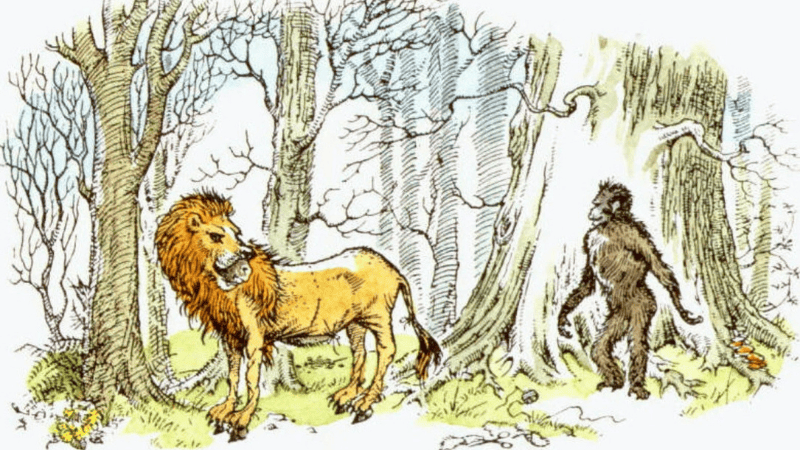
In the case of Narnia, there are no such liberties. Aslan is a male lion. When the Streep rumours surfaced last year, some people criticised it simply because a female lion would lose the mane. While it’s an important visual for the character, constantly mentioned in the way Lucy buries her face in it when sad, and mentioned in the rhyme told by Mr Beaver,
Wrong will be right, when Aslan comes in sight,
At the sound of his roar, sorrows will be no more,
When he bares his teeth, winter meets its death,
And when he shakes his mane, we shall have spring again.
but that’s the least of it. Casting an actress to provide the voice begins to change very fundamental things about the character, and how he will be perceived by audiences.
Aslan is described as having a deep voice, with frequent references to how it sounds like a low growl or a deep rumble, something powerful and dangerous about him, he even uses it to bring walls crashing down. A female voice wouldn’t fit with that description, and would seem out of place in a male lion. Suggestions that Streep’s voice might be modulated to make it deeper are, I think, wrong, and would only make this casting decision even more egregious.
While these are all important, practical considerations for the character, I think there is others, which are even more important to address.
Obviously, there’s the fact that Aslan is a representation of Jesus Christ. Not so much an allegory, as many people mistakenly state, but what Lewis called a “supposal”, that is, what if the events told in the Bible, such as the creation of the world, the Passion and Resurrection, etc, were to happen in another world: a world populated by talking animals and mythical beasts. What form might the Son of God take in such a world? Lewis chose a lion.
That fact make the casting a very important one. Either Gerwig is too uninspired to realise what Lewis meant to convey, which is unlikely, or she’s deliberately chosen to make the change knowing full well the context, and aware of the effect it will have on the story, and anger it will inspire in Narnia fans, and Christians more generally. If it’s the latter, we can only guess at the personal obsessions that drive her creatively.
It’s possible she doesn’t think it a very big change (given the output of Hollywood this last decade I have very little benefit of the doubt left to give) but it is. The fact is that men and women are different, and choosing to switch the sex of a character, particularly one so central to the story and its themes, will have wave-like effects across the whole of the Chronicles.
Aslan is very much presented as a fatherly figure throughout the books. He shows a paternal affection for the girls, particularly Lucy, protecting them and comforting them when they’re scared, giving them courage, and delighting in their happiness.
To the boys, he’s much more of a guiding hand and a authority figure. He teaches Peter how to fight and direct a battle, and instructs him to make his first kill of the wolf Maugrim. He also deals with both Edmund and Eustace when they transgress.
While he’s by no means a cruel tyrant, the children often feel a certain apprehension at seeing him when they know they’ve done wrong, much like they would with a father. To every Narnian he’s a source of joy, but also a certain amount of fear at his awesome strength and retribution against his enemies. After all, he’s not a tame lion.
Perhaps it’s no coincidence that most of the children have fathers who are either absent, dead, or very poor quality, allowing Aslan to fill that role for them.
If this were changed, Aslan would lose some of his danger, to be replaced by empathy and compassion. He (or she) would become a mother to the children, girls and boys alike. Particularly if Lewis himself had chosen to make Aslan a lioness, he would have viewed her very differently, considering the era he was born and raised in.
The very fact that he chose to write Aslan as male is enough reason for him to remain male, and be depicted as such in all adaptations. There’s no need to try and justify it, the onus lies with those making the changes to justify their reasoning, and appeal to fans. As always, though, they don’t have good reasons.
Unlike C.S. Lewis, who had good reasons for writing characters and stories the way he did, these modern day appropriators don’t have his imagination. At best, they are boring and reductive “auteurs”, who believe that subversion for subversions sake is somehow still a bold choice. At worst, they are destroyers, intent on tearing down the things they hate, while expecting you to still show up and pay to watch them do it.
To Netflix and Greta Gerwig, might I suggest that instead of a gender-swapped lion-bird-lizard chimera with rainbow whiskers, you might have simply used a donkey draped in a sagging old lion skin. It would have saved the production millions of dollars, and certainly would have been much more in line with your creative vision.


Leave a comment