The Odyssey might take the trophy for most-anticipated movie of 2026. It’s common, given the nature of the internet, for even insignificant things to blow up out of proportion, but for Christopher Nolan’s latest project, it does seem like the talk was justified, as critics pile praise on it, and IMAX screens sold out for its opening weekend. All the conversations, the criticisms, the glazing, the concerns about Nolan taking on this particular story have come down to this.
Based on Homer’s epic poem, the film follows Odysseus, hero of the Trojan war, on his journey to return home to his wife and kingdom of Ithica.
There’s no definitive process for judging a movie. Intention is important; a trashy action movie might not have a very good story, but no one expects it too, the stunts and shootouts are what people want. For an historical epic, however, the bar is much higher, as are the rewards when done well.
The Odyssey is an epic, and one that expects you to take it seriously, to be changed, even, by your experience, and to leave the cinema with a sense of having witnessed something truly unique.
It might be a stretch to say that Christopher Nolan fails at every aspect of filmmaking here, but he certainly doesn’t excel with any.
There is nothing the movie does that hasn’t been done before, and better. I could damn it with faint praise for one or two neat scenes, but in reality, there’s nothing about the film that stands out or stays with you once the credits roll.
The concerns about changes from the source material and historical inaccuracies are well-documented in YouTube video essays, and unfortunately, all the worst fears were realised. Whether in language, casting, or appearance, it’s ahistorical.
One particular place where it stands out most is the dialogue. Nolan choose to use modern language to make it more appealing to a “modern audience”. Obviously the film couldn’t be in Ancient Greek, but he could have chosen to use more formal English, to give gravity to the words, much like Tolkien did with The Lord of the Rings. There’s no excuse for using American English and accents–not to mention four-letter words–except to condescend to the audience, believing them too dumb to understanding proper English.
More egregious though is the intrusion of modern 21st century cultural, social, and idealistic viewpoints into a three thousand year old tale. It’s not an uncommon thing for the protagonist of a historical movie to appear more enlightened, so as to give audiences a person they can relate to, yet here Nolan actually goes so far as to reprimand his characters for not sharing his outlook.
Characters who were considered bad in the poem, like Circe the witch who transforms the crew into pigs, are now treated as sympathetic and put upon by the supposed heroes. The supposed heroes who Nolan goes to great lengths to diminish. It’s strange that he chooses to do this; surely if Nolan views Odysseus as such a disagreeable character, his actions in the story should speak for themselves, without having to be reinterpreted. Unless he feared audiences might start to root for the wrong hero.
It does raise the question of whether Nolan really wanted to tell this story, or if he’s just using the popularity of it to get the funding he needs. He certainly didn’t put much effort into making it look good.
It looks impressive in places, and does at times look “real”, that is, it looks like real physical objects and sets being captured on film. But what it doesn’t look is realistic; The Lord of the Rings shows us a world that, though fantasy, is completely believable. Every world, culture, and location is realised in such a clear and natural way that you could imagine yourself taking a holiday in the Shire, or finding archeological evidence that Gondor did indeed exist.
Of all the lands Odysseus visit on his journey, none of them stand out. There are a few moments that prompt a “oh look at that!” reaction, but more so in their individual design rather than as part of something greater, of a fictional world that you can disappear into, believing fully that it’s real for 2 hours 53 minutes.
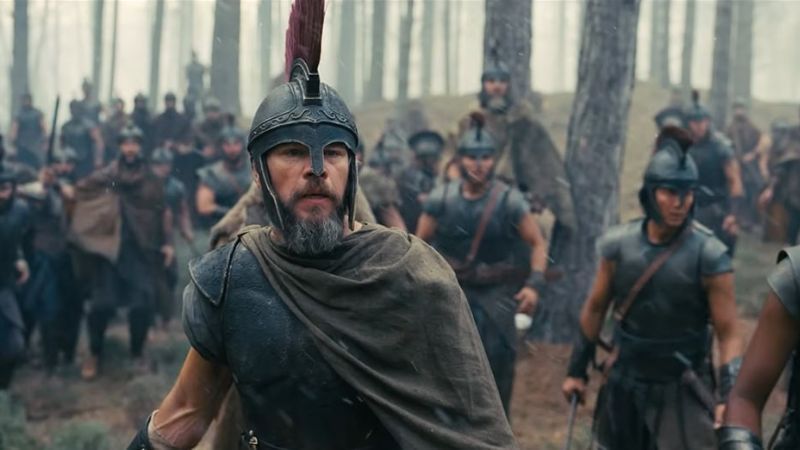
Too often the reverse happens. Something appears onscreen that immediately pulls you out, and reminds you that you’re watching something fake. This is very clear in the armour, of which every design just looks bad. Whether the bulging steel plate of the Laestrygonians, Agamemnon’s Batfleck suit, the flat-faced cardboard Trojan helmets, or Menalaus’s hunting kevlar. Even the Greek armour, which is the best-looking, is always trying to choke out the actors wearing it.
Likewise, the cast are not immersed into their roles. Matt Damon is fine as Odysseus, and John Leguizamo is excellent as Eumaeus, but for the rest, they might be on any set in any production. Robert Pattinson, Zendaya, Jon Bernthal, Elliot Paige, and worst of all Tom Holland, all shine *through* their performance, rather than making us believe they are someone else.
Perhaps the gods were angered by Nolan cutting them from most of the story, and by his cooption of their culture. Certainly, it doesn’t seem that there was much heart and soul poured into this production, where everyone was giving their utmost attention and effort to ensure something spectacular resulted.
Maybe it’s just that Christopher Nolan is losing his touch. It’s been more than twenty years since he started making movies, after all.
Of the best and the worst predictions for what this movie would be, it’s neither. The choices that caused so much controversy, such as the casting of Lupita Nyong’o as Helen of Troy (and inexplicably her twin sister Clytemnestra), and Elliot Paige as Sinon (not Achilles), are strange, to be sure. The easy out would be to say that they aren’t important, as they have so little screen time, but they are important. Not just because the roles are pivotal to the story, but because Nolan chose to go this route despite the limited use he would make of them, causing so much noise before release, and risking the verisimilitude of his film.
In all honesty, The Odyssey is boring, which might be the worst thing a movie can be. Over its near-three hour runtime it does nothing to make you like (or hate) its characters.
It’s a chimera: a strange compilation of things, bound by the work that inspired it, the ideas and ideals within the Ancient world; and yet desperate to break with them, and give you something much more modern and contemporary. Nolan is smart enough to realise the appeal of the original tale, and keeps the vague skeleton here, yet his changes have twisted it into something strange and unnatural. It’s neither a faithful adaptation, nor a complete refutation of The Odyssey, and so it becomes nothing.
It’s not even fun, as each time you might think you can enjoy it, some new absurdity presents itself to shatter immersion. Christopher Nolan has succeeded in undermining what used to be, but as always, has failed to replace it with anything equally satisfying.
Despite the box office and critical success it currently enjoys, I doubt time will be kind to the 21st century version of The Odyssey.


Leave a Reply