
Hollywood’s in serious trouble. That’s no longer something that can be dismissed as just an opinion or clickbait nonsense, the numbers are there for everyone to see. Warner Bros. has been sold to Paramount, there’s a Star Wars movie an track to be the franchise’s lowest grossing, DC is foundering, and the endless stream of sequels, prequels and reboots and giving diminishing returns. Meanwhile, YouTubers are stealing the box office with low-budget horror.
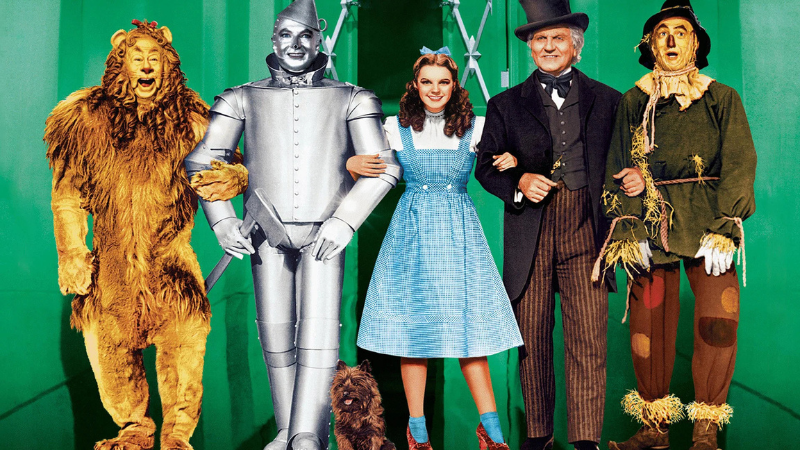
Something needs to be done if the industry wants to save itself. Personally, I think Hollywood would benefit from a visit to see the wonderful Wizard of Oz.
By that, I don’t mean the incredible 1939 classic, and I certainly don’t mean any of the Wicked movies. Rather, that Hollywood needs to take a trip down the yellow brick road to see the man behind the curtain, in the hopes he can give them the gifts they desperately need: a brain, a heart, and courage.
Of these three, the first – brains – is probably the easiest to acquire. Hollywood movies are dumber now, that’s a fact. They’re dumb in both internal and external features.
I don’t just mean things like Godzilla X Kong; there have always been silly, flimsy films of this kind; but modern equivalents are often lazier, more expensive, and more common. I can stand a bit of ridiculous nonsense, on occasion (I like Liam Neeson action movies), but not every time I go to see a movie.
Unfortunately, Hollywood now positions these crass films as its major releases. Things like A Minecraft Movie and the Super Mario Bros. Movie are undeniably very dumb, but still had huge budgets, good release slots, and plenty of marketing.
They’re frequently defended by their supporters with the phrase, “just turn you brain off”, or else, “not every movie needs to be Citizen Kane“. Well, sure, but is it really a good sign if a movie requires you to dispose of all your cognitive functions, just to be able to reach the end credits?
In these movies, characters are treated as cardboard cutouts, with no personality to motivations of their own, simply their to be thrown about from one disconnected scene to the next. Tell don’t show has now become the rule, convenience is required so the plot can happen, and consistency is treated as an afterthought.
There’s some sort of vague amusement to be got from these films. It is sort of fun to see Jason Momoa being loud and funny, but it very quickly gets old, and most of these movies leave you with the feeling that you probably could have done something better with your two hours.
With how common these movies are, it’s becoming a problem. They simply aren’t worth anything. They have no depth, don’t explore anything, don’t teach lessons to children, and give no reason to ever be watched again.
Truly great films are enjoyed for decades, lifetimes even. Star Wars, Jaws, Shrek, Toy Story, Terminator, all have plots that could be reduced down to inanity and demand you “turn your brain off and just enjoy it”, but they don’t. They all feature something more, both in their composition, the way they are filmed, their scores, effects, and design; but also in their stories. They leave you with something unique, memorable, and a feeling you’ve just witnessed something important.
The saying is that a character can only be as smart as the writer, which if true is a terrible reflection of current creatives. Compare the plot, character development, motivations and such of the top movies from the 1970s to the 2000s, and it’s likely they are solid, textbook examples of their craft.
Raiders of the Lost Ark might not be designed as high art, but it will still stand up to scrutiny. The Thing and Alien might only be horror movies, but they don’t require their characters to have seriously low IQ just to keep the plot churning over.
All these movies are still entertaining, yet the definition of “popcorn movie” now seems to be an excuse – or even a defence – for the failures of the writers and directors to create a smart, competent end product; something that can be enjoyed more than once, and enjoyed by people who do like to exercise their logical and quizzical faculties every now and them.
Even more disturbing is how these brainless movies have infested every franchise, No matter how great it used to be, you’re now required to “turn your brain off” (or preferably remove it entirely) when revisiting your favourite IP.
The casualty list is long: The Mandalorian and Grogu, Alien: Earth, Predator: Badlands, Starfleet Academy, Stranger Things, and many more.
But perhaps the worst is Jurassic Park (or World). What began as a smart adaptation of Michael Crichton’s excellent cautionary tale about the dangers of scientific hubris, the power of Nature, Chaos Theory, and risks of corporate exploitation, has now mutated into a story where people who want to cure heart disease are evil, there are “good” and “bad” dinosaurs, and entire events revolve around a discarded Snickers wrapper.
To begin to fix this, Hollywood obviously needs to have better scripts. Ones that can be watched by serious people without causing permanent damage, and that might actually have something to offer, beyond mere sparkly visuals.
With the Scarecrow dealt with, the next problem is the heart.
There’s a particular trend in modern movies that makes me crumple whenever I see it, with its cringeyness, emotional weakness and lack of sincerity. Call it self-aware or Millennial humour, I don’t care, I hate it. It crushes any chance of heroism or profundity, choosing to make cheap jokes instead of powerful moments.
No longer are heroes allowed to be heroes. We can’t have any cool scenes of characters receiving important objects, suiting up, or conveying wisdom, without some smug imbecile having to undercut it with an “are we really doing this?” moment, shattering immersion and cheapening every moment because the director desperately needs you to know that they’re far too cool for this.
This came to prominence in the heyday of the MCU, though it has earlier origins, there it worked most of the time, delivering something that was new, fun and in-keeping with the characters. But since then it’s been copied by every single creative, who doesn’t understand how, when, and where to use it properly. Like every other bad thing, it’s also crept into just about every franchise. Now we have to endure it in Star Wars, Jurassic World, and Star Trek. I don’t doubt it will even feature in The Hunt for Gollum.
In the past, movies would combat the tendency to get too dark by having a comic relief character. Their purpose would be to bring a bit of levity to things, without taking you out of the story. It would be a part of their personality, like R2-D2 and C-3PO in the original trilogy. Now, all characters are both professional comedians and open targets for Taika Waititi style of comedy, undercutting any attempts to be serious.
Even when a movie doesn’t go out of its way to sabotage its sincerity, it still can’t be bothered to have any. The Mandalorian and Grogu is a perfect example of a movie that does this. Where as the original Star Wars had faith in itself and the story it was telling M&G does not. It doesn’t have anything to say about heroism, sacrifice, redemption, or duty. It’s just there to show some reasonably good effects and a few loud fight scenes.
Movies of this kind have become more common in the last few years, but can be traced back to Rise of Skywalker. They’re a kind of accepted mediocrity, without aspirations or intentions. For years Hollywood movies set about the “deconstruction” programme, taking apart the classic tropes of storytelling, and reducing beloved characters like Luke Skywalker and Indiana Jones into weak, failed shells of themselves.
Naturally audiences and fans hated that and spoke with their dollars. The obvious answer would be to reverse the change, and try to put things back to how they were, but Hollywood lacks the humility and skills to do that. So instead they make these mediocre movies by design. Like Mandalorian and Grogu, Electric State, or the heavily reworked live-action Snow White, they’ve been put through the washing machine multiple times to try and rinse out anything that might be offensive, anything that might create a backlash, or turn away what fans remain. They’ve been forced to realise that The Last Jedi was a failure with the effect it’s had on Star Wars, but lack the will to make anything like A New Hope. Instead we get a long stream of Rise of Skywalkers: vaguely entertaining, big budget, most likely with some nostalgia thrown in to get attention. You can’t honestly say they’re the worst thing in the franchise, but there’s so little to praise either. They just sort of exist, and if the studios are lucky, they might make a bit of profit too.
I’m so grateful that the Lord of the Rings trilogy was made in the early 2000s before this happened. I dread to think what it would be like now. There would be no hero moments, or long epic shots of characters just walking across Middle-earth landscapes. There’d be no incredible score from Howard Shore. Instead we’d have constant J.J. Abrams chatter, fast and forgettable action clips, and every powerful moment derailed by awkward humour.
Sincerity, which in its most true form is simply belief in the story you’re telling, is what makes a movie so satisfying to watch, and rewatch again and again. You truly believe, at least for the moment, in what you’re seeing. You want the heroes to win and the villains to lose, because it’s what they both deserve. And when it finally happens and the good guys are allowed their moment of glory, it feels so gratifying. That’s why those films don’t age, because the stories they’re telling are true.
Hollywood needs to discover the way to make fulfilling stories again. Otherwise, you might as well just be watching a TikTok.
A requirement for this will be the third necessity: courage.
This may well be the most important thing, as to rediscover the first two virtues, Hollywood will need a good dose of courage.
Not least will be the courage to admit that they were wrong. Whether they do this openly or privately, they need to admit that their actions over the last decade or so have been disastrous; the fans were right, and were treated with disdain, and the current mess is entirely caused by those within the industry.
Secondly they will need to have the courage to be emotionally intelligent, sincere and solemn where the case demands, as detailed above.
Also, they will need the courage to take risks, to try new things, and move away from their comfort zone. For too long they’ve been relying on established IP, using up a small number of franchises to keep them in business, and being rewarded with diminishing returns, all while streamers like Netflix and foreign products such as anime steal their audience.
It’s true that many of these franchises have afforded them great success for many years, but for how much longer? The Mandalorian and Grogu looks like it will be the lowest-grossing Star Wars movie. No one watched Starfleet Academy. Jurassic World has halved its revenue since the first movie. The MCU can barely take a movie past the half-billion mark. Audiences and fans have gotten bored with these properties, and with not having their concerns taken seriously. They can’t be relied upon to be money makers anymore. Rather than clinging to the franchises that started forty years ago, Hollywood needs to take the bold step to create the new worlds that will serve them for decades to come.
If they are going to continue to use these properties, then they have to be unapologetic in giving fans what they want. Stop trying to make everything about subverting expectations and giving “our take”, and instead just be honest. Give us a suave, self-assured James Bond; a good, morally certain Jedi knight; and a pure, heroic American Superman.
They’ll have to put up with some pushback to begin with, and some unfavourable media coverage, to be able to reap the rewards later. There is a reason, after all, why movies like Revenge of the Sith and Jaws can still make big money on anniversary re-releases.
Without taking the long journey down to the Emerald City, Hollywood won’t be able to fix anything, and will fail. While it might be easy to dismiss them as new forms of alternative media arise, there’s still something about a well-made blockbuster that can’t be replaced by anything else. The combination of spectacle, innovation, character, and craft that come together to create a truly memorable experience that can, indeed, change lives.
But crucially, it has to be said that the Scarecrow, Tin Man and Lion couldn’t actually be given the gifts of brains, heart and courage that they wanted so badly. They had to actually go out and discover them for themselves. So must Hollywood. No one can save them except themselves.

 Films and Fiction
Leave a comment