
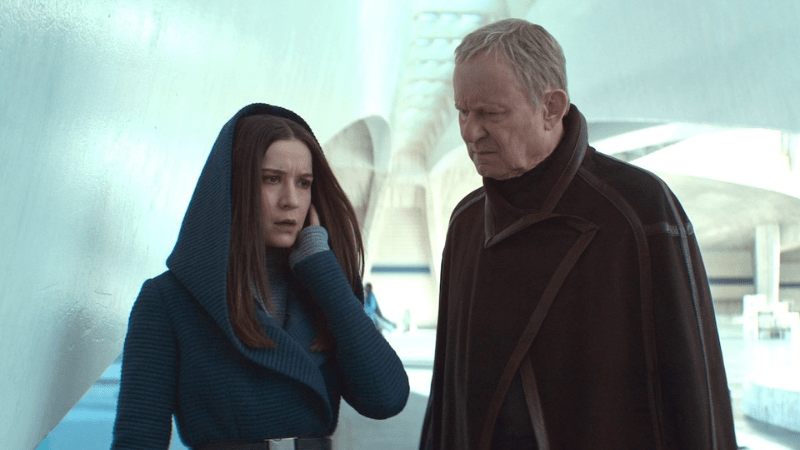
After two seasons, Star Wars: Andor has ended. It’s one of the best received shows Disney has made, but ever since I first watched it, I’ve had the feeling that there’s something wrong with the show, that it’s at odds with the rest of the franchise in some way, and is even deliberately fighting against what Star Wars is.
There’s no doubt that this is a good show. It’s well made, looks far better than most other Star Wars shows on Disney+, has real practical sets, rather than just the volume, and brilliant costumes, and the like. But in many ways, these are just tertiary parts of any production, without a good base of a story, characters, and fictional world, they are useless. I’ll always give a movie or show the benefit of the doubt, even if the effects and visuals look a little rough, so long as there’s some good writing beneath it.
In Andor’s case, there’s no denying that it’s a well-written show. Yes, it can be slow at times, and probably the least interesting character is Cassian Andor, despite being the title character, but it’s still a very solid production.
The problem is that it’s not just a show, it’s a Star Wars show. It can’t just be judged on whether or not it’s good in its own right, as it has the benefit of belonging to one of the biggest, most successful franchises ever created, with a huge fanbase and decades of established lore. The same as any adaptation or continuation of a legacy IP, respect needs to be shown to the source material.
This is where Andor’s biggest issue lies: it doesn’t feel all that much like Star Wars.
What do I mean by that? Well, the first thing is in the look. One of the most iconic scenes in the franchise is the part of A New Hope where Luke and Obi Wan enter the Mos Eisley cantina. It’s packed with aliens from all different species, just hanging around like it’s perfectly normal, which it is in this galaxy. In Empire Strikes Back, Yoda is introduced with little fanfare. He’s a quirky character, but that’s more in his personality rather than his species. The same with Return of the Jedi, with Jabba the Hutt, Admiral Ackbar, and the like. All these characters just exist in this world as a normal part of it. They are as natural as humans, and give the Star Wars galaxy a real depth and make it stand out from other sci-fi franchises.
In contrast, there are practically no aliens in Andor. I can’t think of a single character except the four-armed doctor from season one, and very few background aliens even, particularly recognizable species like Rodians and Twi’leks. There also isn’t a single important character who’s an alien, unlike in other Star Wars projects, where characters like Yoda, Ahsoka, and Chewbacca appear regularly. This is despite the fact that there are several characters in Andor who could easily be another species, as there’s no good reason for them all to be human.
It’s a similar situation with droids. There’s B2EMO, an original design for season one, and K-2SO is brought in from Rogue One, but they aren’t particularly important. In contrast, in Episode IV, the first figures we’re introduced to are R2-D2 and C-3PO, who carry the first part of the movie, have the distinction of saying the first lines, and are really our protagonists until Luke enters. It’s all done so naturally that there’s never any reason to question why a squeaky dustbin and gold tin man are in the movie, they are a seamless part of this world, just another element of this made up galaxy.
Even in the background of Andor, there are few droids. It would make sense that places like the ISB offices would be filled with protocol droids to carry out admin and deal with the huge amount of data passing through the bureau, yet they are absent from most of the show, unlike other films and series, were they are often shown in the background performing menial tasks, even on the Death Star.
There are other points I could add, such as the modernisms with some of the dialogue, and the introduction of our own swear words, and some design choices that don’t match with the rest of the galaxy, not to mention some contentious points, like the depiction of attempted rape.
All this is to say that Andor doesn’t feel particularly like Star Wars. Contrast that with Dave Filoni’s shows like Ahsoka, that have gone incredibly deep into a galaxy far, far away (to their own detriment), and you can see why it’s incredibly jarring to flick between these shows from year to year, and to imagine that they all take place within the same world.
But these are all aesthetic complaints. I think that other complaints can be made, too, more important complaints, about the actual substance and content of this show, the story being told, and the way the characters are portrayed.
One argument you’ll often hear is that Andor is for “grown ups”. I think that’s meant to mean that the original Star Wars, and things like The Mandalorian, aren’t mature enough, and that, for some reason, Star Wars needs to start taking on these more adult ideas, to make it worth the while for older viewers to watch it, hence the attempted rape and heightened violence. I don’t agree with this at all, and even if it were the case that such a show requires a more “mature” tone, then why not create a new universe to set in in, rather than co-opting an existing franchise?
However you personally view morality, a galaxy far, far away has its own ideas, based around the Force
All these changes make Andor a very un-Star Wars show. How is that though? Surely a franchise that’s been around for fifty years, set in a vast galaxy, has the right to expand a bit? Of course it does, but picture it this way: would you want a Star Trek show that’s dark, despairing and full of nihilism? How about a Lord of the Rings movie that doesn’t believe evil exists, or has to be fought against? I wouldn’t, yet Andor is a similar thing to Star Wars.
The original trilogy was something rather different from other movies. The fact they took place in a different, fictional world allowed for a unique kind of story, one that wasn’t all that bothered about being particualrly realistic, but rather appealed to a certain kind of mythic storytelling. There’s a sense of heroes and villains, the fight between good and evil, filled with prophecies and unknown forces. It’s not entirely unlike The Lord of the Rings, though nowhere near as thorough.
Andor doesn’t have any of that though. In fact, the show feels closer to The Acolyte than A New Hope. While that show is, without doubt, irredeemably bad, it has a similar lack of understanding of what Star Wars is, what it’s about, and what rules govern this world, particularly with regard to morality.
However you personally view morality, a galaxy far, far away has its own ideas, based around the Force, an energy that is, quite literally, a force for good or bad. When a Force-sensitive uses their powers in a particular way, or with an intent in mind, they are drawn towards either the Light or Dark side, which can become the driver of their destiny for the rest of their lives.
There’s barely a mention of the Force in Andor, I know, and none of the characters can wield it, but that doesn’t mean it’s not there. It is still working, places like Mortis still exist; there is, essentially, an undisputed source of good and evil in the galaxy, and as a result, an unquestionable source of morality, as sure as if there were an omnipotent deity present.
The characters in Andor are all somewhere on the grey spectrum of morality. They will often kill without thought, even the unarmed. Luthen Rael, one of the key figures of the early rebellion, constantly takes action that he knows will cause suffering and result in many deaths. It’s not merely that he takes this as unfortunate collateral in the war, but rather that the suffering and death is his intention, to incite rebellion against the Empire. In his famous speech from season one, he says that he is condemned to use the Empire’s weapons against them, and sacrifices his decency for this cause, for others. Yet it’s still a choice. Every plan he makes, every action he takes, they are all choices.
In season two, we see how clearly he is willing to cause suffering for his own ends, playing the same game as the Empire, and even walking into their trap, to make the people of Ghorman rise up in resistance, despite the fact they are unprepared, underequipped, and have little chance of success. He does this because he knows their voice will be heard across the galaxy, and indeed, it’s the event that makes Mon Mothma publicly speak out against Emperor Palpatine, before fleeing Coruscant to join the Rebel Alliance on Yavin 4.
This is in stark contrast to the heroes of the original trilogy. Luke Skywalker was willing to risk both the Emperor and Vader staying alive because he wouldn’t kill his own father. None of the “good guys” in Andor do things for the same reason as Luke, Han, and Leia, simply because it’s right. There’s no altruism or nobility in their actions, or even an attempt to do the right thing, even if events conspire against them. Luthen kills Lonni Jung–a man who gave as much to the cause as he did–simply so he won’t be a liability.
Now, you could say that this is merely the point of view which the show chooses to show, these characters who are not quite heroes, or even anti-heroes. Perhaps that’s so, as we know, there are many people in the galaxy who are self-serving, selfish, immoral or amoral, and of questionable quality.
But the fact is not that they exist, but the fact that the show makes them the central characters, the protagonists, and chooses to show them in something like a sympathetic light.
All storytelling is a craft, and the writers have a choice in what they choose to show and in how they make a story play out. Andor chooses to make these the main focus of the story, and to portray them as what comes closest to heroes in the show, or at the very least, the ones who are on the right side, fighting the Empire, which gives justification to their actions, and to have them seen as tragic figures.
This doesn’t have to be the case. It would have been possible to show these characters become heroes, particularly in the case of Syril Karn and the like. This is one of the reasons why Star Wars: Rebels is such a good show, as it has the same ideas as the original trilogy, of heroes rising up to do the right thing, even if the entire galaxy–and some of those on your side–are against you.
As they are portrayed in Andor, though, it would be possible for them to rationalize taking control of the Death Star and using it against Coruscant, justifying the idea that wiping out Imperial Centre, killing the Emperor and his top staff, and destroying the nexus of the Imperial war machine, is the best way to bring the conflict to an end, and is worth the billions of deaths inflicted at a single blow. Then the fear of them using this weapon again would be enough to turn worlds against the remaining Imperial forces, and make them surrender to the New Republic. But would that be too much? Where should the line be drawn, and what separates the two sides when they both use the same tactics?
Previous shows like Rebels (which shouldn’t be discarded simply because it’s a cartoon) make it clear that the rebels on Yavin 4 are trying their best to maintain some sense right despite the pressures. They shun Saw Gerrera because of his tactics, because he uses torture, cares little about collateral damage, and instigates brutal actions that result in innocent civilians dying, and simply lead to the Empire doubling down on the local population, with little benefit to the partisans.
In Andor, there does not seem to be much of a line between the good side and the bad side when it comes to characters like Luthen Rael, or even Cassian Andor. There’s a thread of amorality or even immorality, in their actions, with them being characterized as “necessary”, rather than outright wrong.
Of course, you could draw parallels to real life examples, such as Europe during World War II, where many resistance and underground groups fought back against the Nazi occupiers, even though it often resulted in reprisals which meant the suffering and deaths of innocents.
Naturally, it would be impossible to think of fighting a war, whether in the real world or a galaxy ruled by a tyrant, without there being some collateral. Indeed, there’s the old argument about Luke killing millions when he blew up the Death Star, including civilian technicians. But it would seem to me that there’s a clear difference between trying your best to avoid those casualties, while still performing actions that are essential for the war, even to survival; rather than performing such actions knowing innocents will die, but working that into your plan, or even making that the object or your plan. Or else simply performing these actions as a way to satisfy your own need to fight back without caring who gets caught in the crossfire.
You can talk about the brutality of war, but that’s really not the point. That isn’t where the focus is in Star Wars, which should be about heroes, those who can be looked up to, trusted to do the right thing, or else what is the franchise about?
Imagine it this way, if it were a Star Trek show about a Starfleet captain who always shot first when meeting new civilizations, who broke the Prime Directive, had no sense of wonder, and didn’t believe in humanity’s goodness. I’m sure you could make a good show about that–even a brilliant one–but only so long as that captain was shown to be wrong, with a clear message that the tenets of Starfleet are inherently good, or else it would not be a Star Trek show if he were constantly shown to be justified in his cynicism.
This would seem to me to be the place where Andor fails the most. For all its solid writing, great production design and memorable dialogue, it just doesn’t feel like Star Wars, and even goes so far as to seem antithetical to everything that the franchise is, and should, be about. It’s filled with interesting ideas, but are they ones that should be explored in a galaxy far, far away? I don’t think so. To me, the series has always felt like a sci-fi story that just happened to be set in this galaxy, rather than being immersed in it. A show that wears the drapes of the franchise, with a few TIE fighters, Stormtroopers, and the like, but seems on a fundamental level to misunderstand what Star Wars means, and instead wants to push ahead with its own ideas without ever coming back to reconcile with the story that started in all in 1977. Yes Andor is a good show, a great show ever, but it simply isn’t Star Wars.

 Films and Fiction
Leave a reply to ‘Andor’ Season 2 Acknowledges the Force in the Strangest Way Cancel reply