
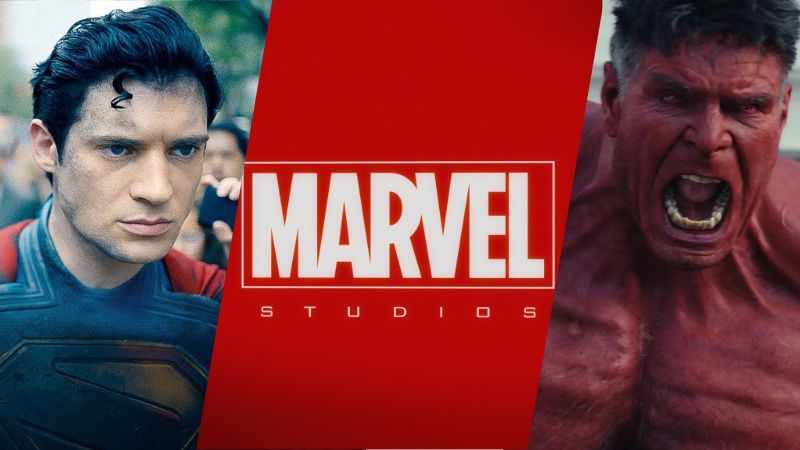
Superhero fatigue is something you hear about a lot, usually following the disappointing release of yet another MCU movie. The big question though is does it really exist, or is it just a phrase invented by YouTubers to get clicks?
The truth is that yes, it does exist, even though it’s usually exaggerated by online hyperbole. But it’s hard to ignore that it is real, and that it’s having a big impact on cinema.
Let’s begin by looking at the numbers behind it all.
The Marvel Cinematic Universe consists of thirty-six movies, eleven of which have made $1 billion or more. Of these, eight were released before Avengers: Endgame, and three after. Of the three latter ones, two are Spider-Man movies, and two rely heavily on nostalgia to get audiences hyped: No Way Home with Tobey Maguire and Andrew Garfield; and Deadpool & Wolverine with Hugh Jackman.
Looking at Phases 1 to 3 of the MCU, which runs from the first movie, Iron Man (2008) to Spider-Man: Far From Home (2019), these movies brought in an incredibly $22.6 billion across twenty-three films, that’s an average of $228M per movie.
Comparing that with Phases 4 and 5, which comprise thirteen movies that have grossed $9.3 billion between them; that’s an average of $721M per movie.
On the face of it, that doesn’t look too bad. $700M is still a lot of money, and an average result for a blockbuster. But there’s more to it than that.
Of the movies released up to Endgame, only three of them made less than $500M, and they were all released in Phase 1, before the franchise had built up momentum, when characters like Iron Man weren’t widely known. Of the movies released since 2019, however, seven of them have failed to hit the half-billion marker, despite the reputation that precedes them. In other words, more have failed than have won.
So is this just MCU fatigue, or is it across the board? Obviously it affects Marvel the most; they were the biggest franchise, so they had the furthest to fall, but let’s look at their main rival the DCEU.
In total, their fifteen movies brought in $7.2 billion, starting in 2013 with Man of Steel (and including Blue Beetle, whatever WB tries to say). Up to Shazam (2019) these movies made $5.2B, which works out at around $750M per movie. Not bad. Aquaman also gave the franchise its only billion dollar hit in 2018.
the eight movies released from 2020 on made just $1.9B, that’s only $239M per movie on average. A terrible result for any movie with budgets and marketing of this scale, which led to the studio doing a reboot this year under James Gunn (more on that below).
There are a few other now MCU or DCEU movies to be counted here too. Sony’s attempts have been pretty lame, almost a joke. Both their Amazing Spider-Man movies made over $700M, but their other efforts have mostly been failures; the biggest hit was Venom (2018) which made $856M, which had fallen to just $478M for its third sequel in 2024. Other notable mentions are Joker (2019), another billion dollar smash, though an unexpected one, and more recently The Batman (2022) with $772M.
2025 has been a very bad year for superheroes. Both MCU movies have flopped, with Captain America: Brave New World and Thunderbolts making less than $500M, while Sony announced the end of their “Sony Spider-Man Universe” (with no Spider-Man).
The biggest hit so far has been Superman, which opened to $220M worldwide, and is looking to finish around the $700M region, if projections are to be believed. This is neither a flying start nor a total failure. Much like the movie it’s “just ok”, and it seems likely the movie will end its run behind other releases like A Minecraft Movie, Lilo & Stitch, and Jurassic World: Rebirth.
So where did it all go wrong?
I think the biggest problem is that the MCU chain has been broken. From, say, Avengers in 2012 to Endgame in 2019, the MCU was a huge force at the box office that meant even mid movies like Black Panther and Captain Marvel could break a billion.
But at the same time, as its name suggests, Endgame was the endgame. It told a continues story across almost two-dozen movies, with a huge cast. It was like anything ever made before, a large, planned, inter-connected cinematic universe, where you often had to see every movie, even if the characters weren’t your favourite, because they’d have an important role later on, which turned minor players like Thor and Ant-Man into big names.
But that ended with Endgame, when Tony Stark’s and Steve Rogers’ stories came to an end. A lot of people left it there, or have dropped out since because they find no interest in the new characters, while Disney have made things worse by piling so much content onto Disney+, which no one watches.
It’s clear from the results of Brave New World and Thunderbolts that less and less people care now. It’s true that the whole industry has taken a hit since 2020, for several reasons, but there have still been many successful non-MCU movies since, even movies that don’t have much creative merit, like the Jurassic World series.
There’s some precedent for this. Trends tend to come and go in Hollywood, with a huge peak before it falls off a cliff, like the sci-fi boom following Star Wars or the craze for action movies in the ’80s and early ’90s, which both faded out.
A more recent example which in some ways preceded the superhero revival is the fantasy hype, which began in the early 2000s with Lord of the Rings and Harry Potter, sending studios into a frenzy to option as many fantasy and YA novels as they could, with things like Narnia and Percy Jackson, before the whole thing ground to a halt in 2012 with the release of Harry Potter and the Deathly Hallows: Part 2.
Likewise, the success of those early Marvel movies led DC to rush out their own competition before it was ready, and without taking the time to build up slowly and steadily, expecting those huge hits straight out of the box.
It also has to be taken into account that the quality of these movies has fallen in the last few years too, and have begun to focus on less well-known characters. This is only natural when you consider the scale of releases.
Since 2016 there have been at least five major superhero or comic book movies released every single year (except 2020). That’s a lot of films, and a lot of the same, as many superhero flicks follow similar patterns; the responsibility of power, learning humility, saving the world. Obviously these are ancient stories, but the superhero genre has become more rote lately, as the MCU adopted its house style, and there’s only so many times you can see New York be destroyed.
With such a high quantity in such a short time, it’s natural that there’ll be a drop in quality, while both creatives and audiences will start to feel tired of seeing so much of the same.
Does that mean there won’t be any more big comic book movies then? No, they will still be here, but I think there will be less of them, and those that are successful will need to have their own unique style, probably focusing on the most well-known characters, but I think the era when there would be three MCU movies making $1 billion each in one year are gone.
For now, the best thing studios can do is give audiences a rest. Let them recover from their superhero fatigue and take it easy for a few year, then maybe in the 2030s we can have another revival.
 filmsandfiction.com
Leave a comment