
Andor is very nearly the best thing to come out of Star Wars under Disney’s ownership, but there are so many little things that stop it taking that title. It looks like Star Wars, it has some Star Wars references in it, but it just doesn’t feel like Star Wars. It seems more like just another sci-fi show, a good one, yes, but not Star Wars. This makes one decision taken on season two all the more strange.
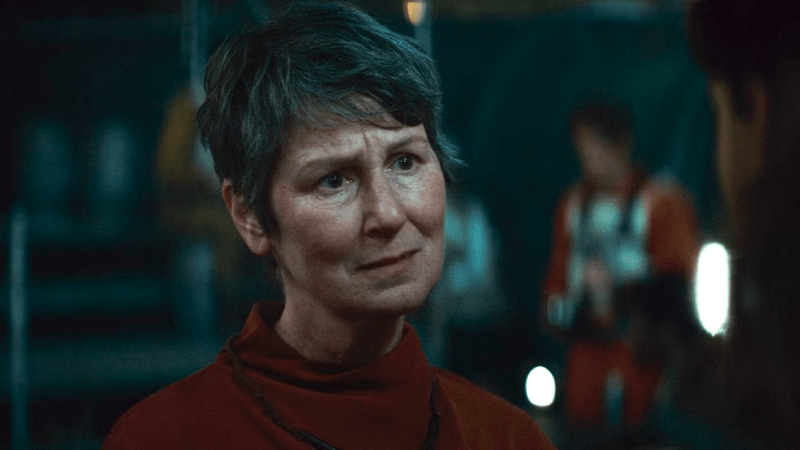
It comes in the third arc, set a couple of years before Rogue One, on the Yavin 4 base. Andor has a wound that’s not healing, and rather than using bacta, which is the common treatment for such things, he goes to a woman who calls herself a Force healer. In itself, this isn’t all that surprising. There are hundreds of people in the galaxy who would have some level of Force sensitivity, but either weren’t skilled enough to join the Jedi, or simply lived in the Outer Rim or somewhere outside the Jedi’s jurisdiction. They would have developed different ways of using their powers, or else play upon other people’s beliefs in the Force to scam them.
It appears that this Force healer is sincere, though, and has some skills that make her a valuable asset on the rebel base.
It so odd that the show acknowledges the Force in this way, as throughout the rest of its run, it’s completely ignored it. Granted, it’s not essential to the plot, as none of the characters are Force-users, and it’s mainly concerned with the politics and administration of the Empire and Rebellion. Even so, it’s completely absent and unmentioned, apart from a few curios in Luthen’s shop; there’s no mention of Vader or the Emperor having this power, or even an acknowledgement that the Jedi ever existed. So the decision to introduce it at this stage feels more like a plot device than anything integral to the show, a way to get Bix out of the picture to allow the events of the following movie to happen unhindered.
It’s a strange thing–possibly done in an attempt to make Rogue One seem more important–but there’s a hint that Cassian Andor is bound by fate; that he’s on a journey of rebellion that can’t be altered, and for the good of the galaxy, Bix leaves him to raise their child alone, so he won’t abandon the rebels for her.
Obviously, for anyone who knows the plot of Rogue One, where Cassian gives his life to obtain the plans to the Death Star and transmit them to the rebels, he clearly is an important character in galactic events, and who knows how things would have gone if he’s abandoned the cause? The problem is that until now the show has done nothing to suggest “…that there’s one all-powerful Force controlling everything.” In fact, the acknowledgement of it changes the way the show has to be viewed.
The Force is certainly something like the balance between good and evil. It’s out of balance during the Empire’s reign, and needs Luke and Anakin to correct it. How it works on a mechanical level, beyond midi-chlorians, isn’t very clear, but the existence of such a force in the galaxy has to change the way to view actions morally and ethically. And nothing in Andor suggests the main characters are much bothered by ethics, or at least can justify their disregard, with the tactics they use against the Empire. But by implication, it would seem hard to do bad actions for good reasons and succeed under such a system. Is everyone bound by destiny? Do they not have free will? Are even those who can’t use the Force governed by the same rules? It certainly opens up a lot of questions.
Introducing this Force healer is an odd choice when there are already two Force-sensitives on the Yavin base, both far more skilled than her, Kanan Jarrus and his padawan Ezra Bridger. Clearly Tony Gilroy isn’t one for cameos, and it would require casting Kanan for live-action, but surely he would have a better sense of Cassian’s fate than this random healer. And why had he never spoken to her, or why did Ezra not question her to learn all he could about the Force?
Quite why it was felt necessary to include the character at this late point I don’t know. There’s been nothing in this show or Rogue One to suggest that Cassian is being urged on by fate. He’s on a journey, yes, but one that’s more his own realisation that there are bigger, more important things than just what he wants. There’s no reason to treat him as a special individual, any more than Lando Calrissian, Wedge Antilles, or the countless rebels who play vital roles in the Empire’s downfall.
Does this now mean that they are all somehow ruled by the Force? After all, if it weren’t for Jyn Erso, Admiral Raddus, and the rest of the operation, the plans would never been given to Leia on the Tantive IV.
Obviously the Force, and the mysterious power of the Whills, must have some input into the galaxy, but to what extent do they interfere? I’m sure there’s plenty to be explored here, but this isn’t the way to do it, and Andor is not the show for such explorations.
 Films and Fiction
Leave a comment