As an Amazon Associate, I earn on qualifying purchases made through affiliate links on this site.
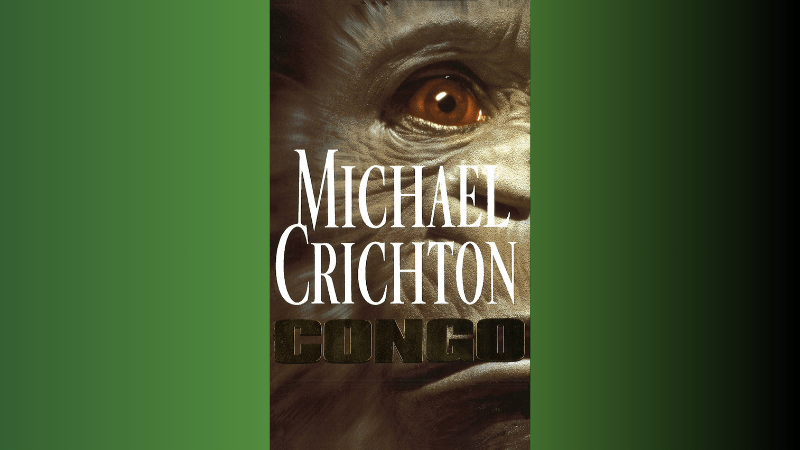
After finishing The Lost World, I decided to check out more of Michael Crichton’s work, and settled on his 1980 adventure novel Congo. That might have been a mistake.
Set in the 1979, the race is on to secure blue diamond deposits for use in computer chips. The Congo looks like a rich source of them, but not just anywhere in the Congo, none other than the Lost City of Zinj (AKA King Solomon’s Mines). When a survey team disappears in mysterious and brutal circumstances, the company sends out another team to get to the site and keep the diamonds out of their rival’s hands. As you might expect, things don’t go well, and there’s more hiding in the dense jungle than just a lost city.
This was written before Crichton’s two more famous works, the Jurassic Park novels, and I might say that shows, it it wasn’t for the fact this is his fifteenth novel, so he’s not exactly a novice. As it was, I found this quite difficult to get through at times.
The conceit of the book is that it’s written as a recording of what happened on the expedition, with Crichton’s author collecting statements from the team, and combining this with other data to get a full picture of what went wrong. This is fine as an idea, but it’s not stuck to. There are things included that wouldn’t be known, or at least wouldn’t have been seen that way by the people involved, and this seems to be a problem for Crichton, as he doesn’t stick to the conceit all that closely. Really, it would have been best to write it as a ordinary narrative, especially as the quotes from characters speaking after the event means you’re certain they make it out alive, something that’s not so clear in the Jurassic books, which can be quite brutal.
On top of this, the first half of the book is incredibly slow. It’s mainly concerned with setting everything up, introducing characters, and providing a ton of backstory for everything, but it all happens so slowly with it feels like plodding through mud. There’s no build up of tension, because it takes so long to unravel, and it’s not until they get to the second half and begin their expedition into the Congo that things pick up, and you actually get a sense of stakes and danger, with hippo attacks, marauding tribes of cannibals, and a race against their competitors to secure the diamond fields first.
As you’d expect, Crichton has done his research once again, no doubt about it, this time into computer chips and sign language in primates, but none of it feels natural as in the other books. It’s inserted in great blocks, with long pauses in the action to explain what something is or why it’s important. This could by why he chose the mission report conceit, to allow for this, but it doesn’t work, and really drags the story down.
It’s interesting to compare this book to the one it takes inspiration from, H. Rider Haggard’s King Solomon’s Mines, from 1885, the first novel to feature Allan Quatermain. That’s a much more brisk affair, with three very British gentlemen setting off on an expedition with minimal supplies, to find the lost mines, and ending up fighting in the middle of a civil war as a result. It’s much more of an adventure, with never a dull moment, and far less attempts to make everything seem realistic and backed up by research.
While there’s nothing wrong with Crichton’s approach, Congo isn’t anywhere near as engaging as King Solomon’s Mines, not least because its characters aren’t really interesting. There’s Elliot, an academic who teaches gorillas sign language and is well out of his depth in the jungle; Ross, the arrogant and assured leader of the expedition, who’ll do anything to get to the diamonds; and Munro, a former mercenary tasked with escorting the team into the Congo safely. He’s by far the most interesting character, the sensible type, speaking from experience rather than theory.
Sadly, despite its interesting premise, the book falls flat. There’s never really anything exciting happens. Even right to the end, it feels lacking in something. Once we get into the jungle, it feels like it’s in a massive hurry to get out of there, and we don’t get any big revelations or deep insight quite so much as the dinosaur-centric novels have. Those big ideas and searching questions are there, but don’t amount to anything in the end.
Guess I’ll have to see what the movie’s like!
Thanks for reading! I’m looking to grow my audience for my blog, so would really appreciate any help you can give. Please consider liking this post, and sharing it on social media. You can also subscribe to receive posts by email, and follow me on Twitter and Facebook. Also, if you’d like to, you can donate through Buy Me A Coffee to help keep things running!
Thankyou!
 Films and Fiction
Leave a comment