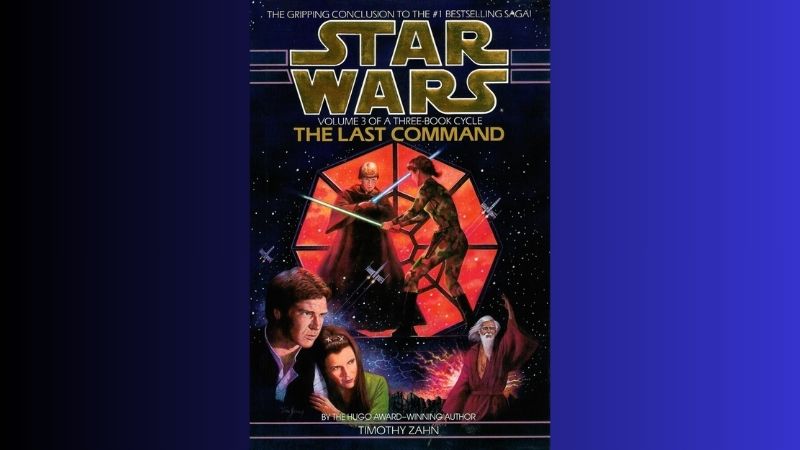
With The Last Command, Timothy Zahn brings his infamous trilogy of Star Wars novels to an end.
Released in the early nineties, these books, known as the Heir to the Empire trilogy, went on to become some of the best loved examples of Star Wars literature. At the time, the franchise was going through an empty space between trilogies, with little to interest the dedicated fan. Zahn’s novels changed that, with his story of a resurgent Empire, clone armies, and mad Jedi capturing readers attention, and his main protagonist becoming a hugely popular villains, going on to appear in Star Wars: Rebels and Ahsoka.
Bringing the trilogy to a close, The Last Command plunges the galaxy into war once again, as the fragile Republic has to deal with the remains of the Empire under Thrawn’s command, as the Chiss master tactician brings all his plans into play to take control of the galaxy.
Maybe I’m biased because I’ve just finished reading it, but this is the best of the three books. It’s got a strong story and doesn’t waste a moment, with something always happening. Like any good final act, it raises the stakes and ramps up the tension right to the very end.
Among its strongest aspects are Grand Admiral Thrawn and his master plan to bring the Empire back. Every detail is planned out, as he juggles all the various threads which will bring him to power. Some of his best tactics are on display, like the siege of Coruscant or his ingenious method for counteracting planetary shields. This is the brilliant and deadly Thrawn we need to see onscreen.
The book’s not without problems. One of the weakest parts in the reveal of who the mysterious “Delta Source” is that’s been sending information to the Empire from inside the palace on Coruscant. I guess this could have been something Zahn had planned from the beginning, but it felt like a missed opportunity to have an established character revealed to be an Imperial spy.
I’ll also repeat my criticism of Zahn’s prose. Almost every new chapter opens with a quick scene setter in the style of “Thrawn sat in his command chair looking out into space”, which gets repetitive after a while. I also can’t count the number of time he’s used “Luke looked” rather than finding an alternative. It’s a very simple and efficient style which sometimes drifts into an omniscient viewpoint, and doesn’t always get across the depth of the story being told or the galaxy-spanning epicness of the setting.
It makes me wonder if these books would appeal to someone who’d never seen the original trilogy? There’s something lacking in the worldbuilding and descriptions, and the prose doesn’t put you into a galaxy far, far away. I know what a Star Destroyer or X-Wing or Wookiee looks like, or can make an educated guess, but would an average reader get them? You could argue that this isn’t Zahn’s concern, as he’s writing primarily for an audience already familiar with Star Wars, and writing for established fans, but it would be interesting to know if anyone ever came to the franchise through these books and went on to check out the movies.
One bad thing about being a Star Wars fan is you often hear spoilers for stories you’ve never read. In this case, I knew Thrawn’s fate long before I read the book, and as the chapters ticked down to the end, could make a guess at exactly what was going to happen, which spoilt the tension quite a bit.
Looking at the Heir to the Empire trilogy as a whole, I can see why they were so popular when they came out (and remain so thirty years later). It’s true a lot of things have been retconned since then, especially regarding the Clone Wars, but with a few tweaks, it could easily have been brought to the big screen with the original trio of heroes as its leads, which must surely be one of Disney’s biggest missed opportunities.
Here though, as a final act of the trilogy, The Last Command is as strong and satisfying a conclusion as you could hope for, and shows just how much potential there is to tell new stories in this galaxy.
 Films and Fiction
Leave a comment