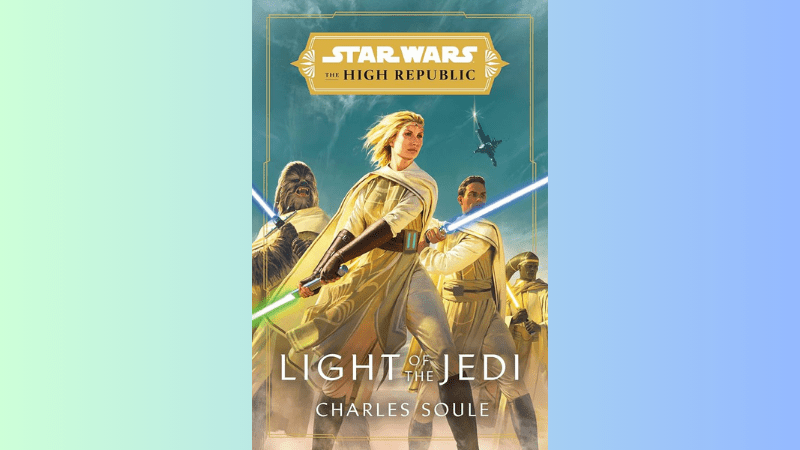
Light of the Jedi is the first book in the multimedia Star Wars project set in the centuries before The Phantom Menace, in an era known as The High Republic. While this is one of the most popular books in the franchise, it has a lot of faults; faults that unfortunately meant I didn’t get into the story the way I would have liked.
The problems start right with the first chapter, where the book reveals a recurring flaw. It opens with a cargo freighter transporting colonists out to the worlds of the Outer Rim. We’re introduced to the ship’s captain, former military officer Hedda Casset. Everything’s going fine, until she is abruptly killed off at the end of chapter one, and we never hear of her again.
Sadly, this isn’t just a one off occurrence. All throughout the book, viewpoints jump from character to character, sometimes giving them less than a chapter to themselves before moving on, not always to return, and it’s hard to keep track of who’s who.
It’s just too much in a book that isn’t that long. You can’t focus on so many characters and engagement suffers as a result.
I can see why this happens. Trying to set up a new era of Star Wars isn’t going to be easy, and to give it enough force, the events of the book have to be galaxy-wide, meaning we get to see the viewpoints of a bunch of important people. Unfortunately this comes at the expense of any genuine character development. Even after a full novel with them, I hardly know anything about them.
The characters simply aren’t memorable enough. They lack personality and individuality. I can’t say I know or care much about Bell Zettifar, Avar Kriss or Keven Tarr. I simply haven’t seen them do enough or spent enough time in their company to form an attachment. It would have been better to ruthlessly cut the number of viewpoint characters, leaving us with four or five main ones we can really get to know.
All this jumping about means we get to see the same events from different viewpoints. This is interesting to a point, but it gets dragged down by a sense of repetition. Again and again we’re told who characters are, what plot is happening, what this location is like, without giving us anything useful.
Charles Soule’s prose isn’t the best either. Almost every chapter begins in the same way, and we hover away from characters with a kind of omniscience. Dialogue is extremely dull too. It could be said this is only natural for Star Wars, but it’s annoying to see supposedly intelligent politicians and Jedi talking in blunt, stilted terms, with no nuance or edge.
It’s also the case that Soule uses a great deal of “tell not show”, rather than the other way around. There are great chunks devoted to exposition, explaining everything that’s happening, rather than showing characters having to deal with it.
There are parts that stand out from the rest. It’s an interesting era to explore, seeing the Republic and Jedi at their height, before the corruption and collapse of the Clone Wars. There’s a lot to explore here which is what makes the book feel so thin, as it presses everything too thin to fit it all in, trying to show us the Chancellor, Jedi, military, Outer Rim, and the threat of the Nihil.
Marchion Ro is intriguing, but I think the Paths and the delving into the science of hyperspace is a bad route to go down. It’s always been the case that hyperspace just is, and the more it’s explored, the less believable it becomes.
It all feels like a wasted opportunity, and not the best way to start The High Republic. Even though there’s room for maneuver, the basic principles set out here have to be adhered to, which seems like a tough constraint for any future writers.
Thankyou for reading. If you want to support my writing, please click the button below which will take you to my Buy Me A Coffee page.
 filmsandfiction.com
Leave a comment