The Netflix Chronicles of Narnia adaptation has finished filming and is now in post-production for a release in November this year. There are lots of reasons why I’m not confident in this adaptation (more on that here), but one I’ve not seen mentioned anywhere might seem counter-intuitive to fans, but it’s a problem that’s affected other adaptations in the past: its budget.
I don’t know how much the movie has cost. I’d imagine it’s a fairly high number, considering it’s a well-known property, is going to be released in IMAX so needs good effects, and has a big-name director attached. For comparison, The Electric State was the Russo Brothers’ latest film, a big-budget sci-fi with a reported cost of $320M, the most expensive movie Netflix has ever made. On the other side was Damsel, a run of the mill forgettable fantasy starring Millie Bobby Brown, which reportedly cost over $140M.
I’d expect The Magician’s Nephew to have a price tag of something close to $200M. It’s a pretty standard cost for movies now, especially effects-heavy productions. Yet this hefty budget is more likely to be a detriment to the film, as another movie shows.
The 2005 Walden Media adaptation of The Lion, The Witch, and The Wardrobe had a budget of $180M at the time. That’s something like $300M after inflation is taken into account. Not surprising considering how much CGI was needed to bring the animals to life, and the expectations placed on it by the studio.
But that high price tag didn’t help the movie succeed as an adaptation. It actually harmed it.
The movie was greenlit after the double-shot of Lord of the Rings and Harry Potter proved that fantasy, and British fantasy at that, could be global hits. The Narnia books were still popular, so studios scrambled to get their own piece of the fantasy pie. After seeing the billions it could potentially bring in, Disney and Walden media gave it a huge budget, to compete with the epic fantasy of LOTR, and lost the franchise’s biggest attributes.
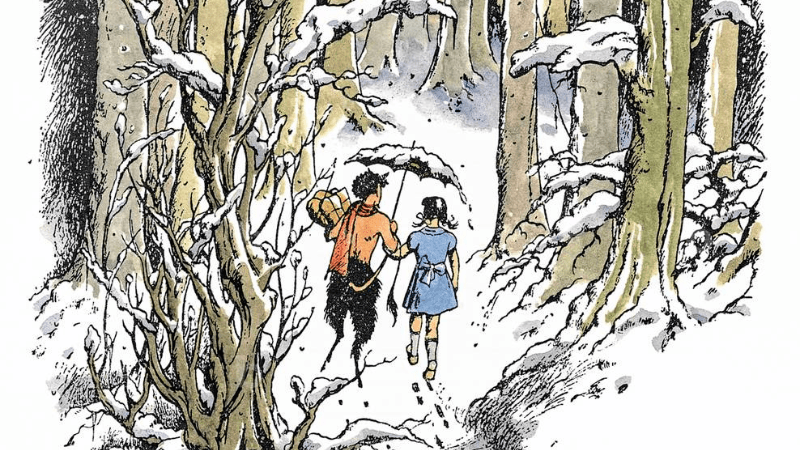
Narnia is sometimes referred to as high fantasy, but it isn’t; it’s really a classic children’s story, a piece of English Literature with some fairytale elements, made into something unique by C.S. Lewis. There are bits of the Greek myths, some Norse mythology, umbrellas, sewing machines, and even Father Christmas thrown in for good measure.
It’s not a meticulously crafted world like Lord of the Rings, and while J.K. Rowling’s worldbuilding is somewhat retroactive, it’s still more cohesive than the structure of Lewis’s world ever was.
That’s no criticism of Lewis. If his stories were created any differently they would lose some of their charm, but it does mean that those adapting his work must take a different approach, if they want to get it right, that is.
The fact is, there’s not so much that’s epic about Narnia. Even in its very size it’s a small land, with very few inhabitants and none of the vast differences and complex history found in Middle-earth.
The focus of the story are the characters, the children who find themselves in Narnia and who, for the most part, are not particularly remarkable. They might go on extraordinary adventures, but they are just ordinary schoolchildren, with no special powers. There aren’t any truly epic quests, or world-destroying events, or all-powerful evil: it’s a smaller world, a smaller story, and that requires a different approach.
In the 2005 movie, you can clearly see the influence of its Middle-earth peers. There are so many sweeping vistas, great mountain rages, a sense of scale and scope that culminates in a huge open battle, as the two armies clash in epic fashion.
But that’s not really Narnia. Even the designs feel overworked. That’s no shade on the people who created them, they are, undoubtedly, incredible pieces of craftsmanship, but they lose the smaller, personal, more intimate quality that the books have.
Lewis writes with a sparse, economical prose, that gives you just enough to form an outline and allow your imagination to do the rest. You get to follow these very ordinary characters on their adventures, and experience the wonder and excitement from their point of view. He frequently breaks through as you hear his voice as the narrator, drawing comparisons to things from our own world, or explaining complicated ideas to his young readers.
So much of Narnia is a simile for England in the first half of the 20th century. The Narnians have tea, eat English breakfasts, and have a certain respectability that’s much more explicit than the analogy of the Hobbits in Tolkien’s work.
Perhaps as an addition to Parkinson’s law we should add that films expand to use up the amount of money available for their completion. It would be a rare director who handed back millions of dollars to the studio because they didn’t need it. Not to mention the studio expecting a certain amount to be spent: in Hollywood, bigger budgets mean better films.
The 1980s BBC series was something of the complete opposite. While it was one of the biggest productions the BBC had ever undertaken, it was still much smaller than what a Hollywood studio could manage, and the VFX and creature design weren’t quite there yet. In some ways, though, it was closer to the spirit of the books. It was, so to speak, more English, more personal, more about the story than the visuals. Dare I say it was “quaint”. And while there’s nothing quaint about the stories, which are really quite dark, I think the biggest reason they’ve become so popular over the last seventy-five years is because of how inviting they are. What child hasn’t wanted to find a world in the back of a wardrobe, to go to Mr. Tumnus’s for tea, visit the Beavers, or spend an afternoon with Puddleglum.
The stories are filled with so many small moments that draw you in, and is much more like The Wind in the Willows — a book which similarly disguises its maturity — than an epic fantasy tale.
I don’t think any large studio or streamer can achieve this now. Perhaps the best chance would have been a BBC or ITV show in the early 2000s, when they might have gotten the effects right without losing sight of the personality that makes these stories unique.
Like so many fantasy films of that era, the Walden Media adaptations tend to try and copy rather than create, to upscale the film to compete on another level rather than allowing it to be its own thing. This time, Netflix will likely want to compete with things like Game of Thrones and Ring of Power.
This will be even more pronounced with The Magician’s Nephew which takes place mostly in London, which means there’s a greater likelihood they include new scenes, such as the destruction of Charn to pad out the runtime.
I wouldn’t say the tendency to view the Chronicles of Narnia as epic fantasy is my biggest problem with the upcoming Netflix movie, but I do think it’s one of the many reasons why we’ll never now get a truly accurate adaptation of C.S. Lewis’s work.
 Films and Fiction
Leave a comment