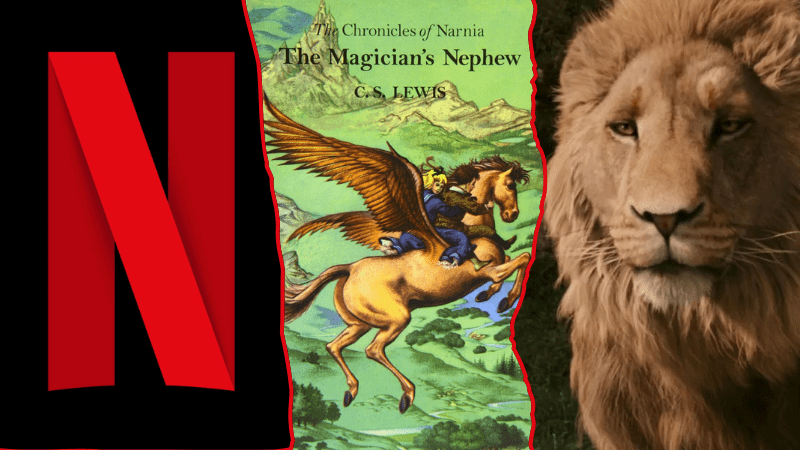
If I had to choose a single book to take to a desert island, it would probably be The Chronicles of Narnia (the seven-in-one omnibus edition), so there’s nothing I’d like more than to see a good adaptation of it onscreen. Sadly, I don’t think that will ever happen now.
There have been several adaptations of C.S. Lewis’s series so far, and each one has its own good and bad points, but for me there’s no definitive version, so the upcoming Netflix movie could be a chance to put that right, but the more I hear about it, the more I lose hope that it can do justice to this story.
Each of the previous adaptations of the Chronicles gets something right about the world: the 1980s had some pretty low-quality effects, but it still stuck close to Lewis’s writing, even lifting entire chunks of dialogue straight from the book. The problem was, this made it a bit perfunctory. There’s nothing that really stands out about them, except their quaintness. The 1978 animated film was another close adaptation, with a simple art style that works well for the series, but once again, there’s nothing that really stands out about it, except the excellent voice cast in the British version.
Probably the best chance we ever had was with the 2005 Walden Media film, The Lion, The Witch, and The Wardrobe. By this time, the technology had caught up with Lewis’s imagination. It was possible to make talking beasts come to life without having to resort to dodgy costumes, and it finally had the budget to do this fantasy world justice–in fact, it probably had too much budget.
Coming straight after the success of the Lord of the Rings trilogy, they tried too hard to be epic fantasy–something the Narnia books are not–and the personal story and intimate world was lost.
This could have been the perfect time to adapt the Chronicles; it was that period of transition when practical effects were still heavily used in movies, but CGI had also advanced far enough to be a useful asset for filmmakers. The movie also had a great cast, score, and talented people involved, such as Weta Workshop, the New Zealand effects shop that worked on Lord of the Rings. But once that window closed, all hope of a successful adaptation faded.
I say that every previous adaptation got something right, but Greta Gerwig’s could be the first attempt to get everything wrong.
She’s obviously a talented and successful director, but that doesn’t mean she’s the right person to bring Narnia to the screen.
Details are scarce at the moment, as it’s not due to release until November, but despite no official confirmation, it’s clear now that Gerwig is adapting The Magician’s Nephew. This was the sixth book published in the Chronicles, in 1955, but it serves as a prequel to all the others, taking place in the early 20th century, in the Edwardian era, and telling the story of Narnia’s creation as a new world.
From all the behind the scenes photos and leaks, it looks like the story is being updated, to be set sometime around 1955. This means that if they follow the timeline of the books, Wardrobe will be set sometime in the ’90s. As Gerwig was born in 1983, this could be a deliberate update to set it around the time she was a child, and likely read the books for the first time.
I don’t believe that the past is another country: it’s inextricable from the present, as the trunk of a tree is from the greenest shoots. But in many adaptations of period pieces (and TMN is really as much a period piece as it is fantasy), there’s a kind of disbelief on the part of the writers, as though “they couldn’t really have spoke or acted like that, could they?” It’s an inability to understand that people did think and act differently, that their lives were different, their morals, and customs. At best, they can only adapt these things as a sort of parody, incapable of realising them honestly.
Recent adaptations of classic works by authors like Dickens suffer from this kind of “modern think”, and upcoming adaptations such as Enid Blyton’sThe Faraway Tree or the Young Sherlock series look like they will be the same. Modern writers just can’t not touch, twist and distort a work to make it more current, and to fit with up-to-the-moment opinions and trends, making it grotesque as a result.
This clearly can’t just be because “kids won’t understand it” if it’s reproduced faithfully. Many of these other “modern” adaptations are made for adults, explicitly, so that doesn’t work as an excuse for meddling. It’s as though the writers can’t remove themselves from the work they are adapting: they think a certain way, so these characters must too; they can’t abstract.
Then comes the dread influence, where these “adapters” have to include their own personal experience in whatever they make, as Lesleye Headland did with her anti-Star Wars show The Acolyte. Regardless of how it fits into a previously established fictional world, their own beliefs must come first.
Why they must always come to a well-loved franchise to do this, rather than creating their own original story, I don’t know.
Maybe there’s a reason these books have been best-sellers for decades, passed on from generation to generation. Maybe there’s no need to change them, to update them to remove anything unpalatable in the 21st century. Maybe C.S. Lewis, the man who created this whole imaginary world, knew what he was doing, and why he was doing it.
Narnia is an old work of literature. It’s more than seventy-five years since the first book was published, and that means it can’t be compared to modern equivalents (though it beats them all); it will obviously be different, but it’s that difference that makes it unique. If it were written now, it would be unrecognizable; it’s a product of the time, place, and circumstance in which it was created.
Lewis was a soldier, a veteran of the Somme, who became an Oxford professor, a student of history, literature, English, and mythology, and a theologian. He didn’t just create the world of Narnia to make a bit of extra cash, he crafted it with a purpose. Almost every line, character, plot point, and place has a greater meaning to it, some allegorical or analogous purpose in the broader story. Many of them you don’t notice until you’ve read the books several times, but would still spark some thought in the mind of the reader from the first.
The Christian element is not a subconscious addition, it’s an integral part of the story. Lewis described it as “suppositional”, where the stories from the Bible played out again in another world, where the Son of God appeared in physical form to save a doomed world, only this time it was a world filled with talking beasts and mythical creatures, so he chose the form of a lion instead, and went by the name of Aslan.
These elements are intrinsic to the story, deciding to remove them from your adaptation, not due to necessary time, budget or practical constraints, but because you believe you can improve it is rather like cutting up Da Vinci’s The Last Supper because you can “make it better”.
But it’s not out yet, and as I write this, it’s still filming, and we’ve yet to have any official stills or trailers, so why not give it the benefit of the doubt until then?
The answer is in Star Wars, Star Trek, Lord of the Rings, Jurassic Park, Predator, Alien, Terminator, Ghostbusters, Toy Story, Gladiator, Indiana Jones, and the many other properties that have been subjected to “modern think”; torn up, subverted, and destroyed by greedy corporations and arrogant creatives.
I don’t owe them anything; it’s up to them to prove to me, and to all Lewis fans, that they deserve our trust. Making judgements is essential, as much to express your lack of faith as to express your hype. If I’m mistaken, I’ll say so, but nothing I’ve seen so far has given me any hope. From the rumour that Meryl Streep is voicing Aslan–which is unfortunately all too believable–to a producer describing it as very “rock & roll”, to the CEO of IMAX saying this is “not your mother’s or your grandmother’s Narnia”, and the less-than-convincing casting announcements, it seems that the Chronicles of Narnia could be about to suffer the fate of so many franchises before it.
The deconstruction of heroes like Luke Skywalker and destruction of so many well-loved stories isn’t an accident, it’s a deliberate subversion to try and improve them, and to show fans that really, these were not role models anyway.
Is it likely that in 2026, Netflix will make a movie based on a Christian allegory, with clear morality, heroes and villains, consequences for one’s actions, and that is a product of a time more than seventy years ago? Or is it more likely that we will get the updated version, where Greta Gerwig makes Jadis a sympathetic and misunderstood character, and Polly is a very modern heroine?

 Films and Fiction
Leave a comment